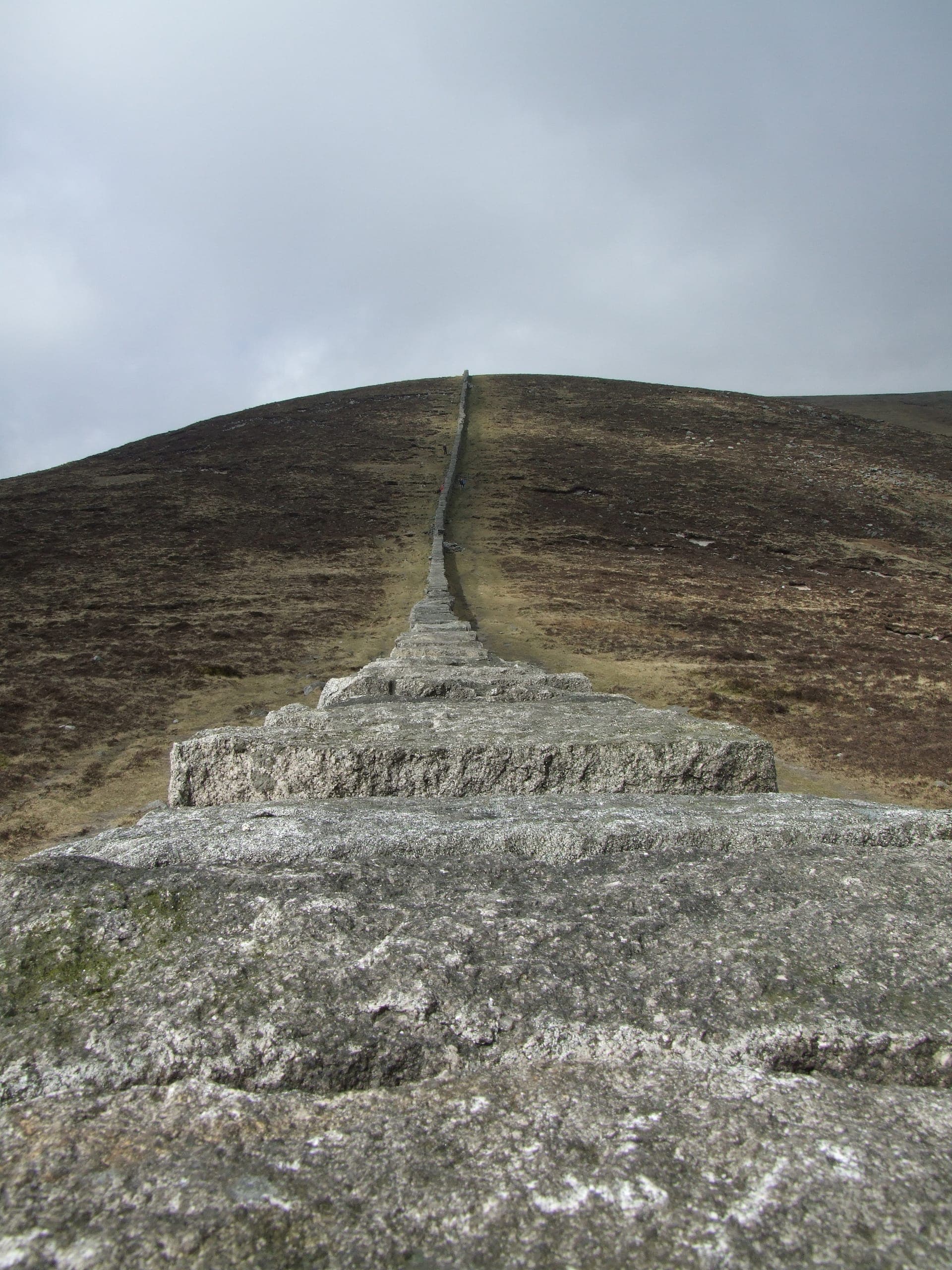
22 Miles Across 15 Summits: The Wall They Built by Hand
Dry-stone granite. Eighteen years of work. Stonemasons who camped under tarps and climbed three hours before lifting a single stone. The Mourne Wall is still standing.
Location
Mourne Mountains, Co. Down
Length
22 miles (35 km)
Summits Crossed
15 peaks
Built
1904–1922 (18 years)
Wall Challenge
2,440 m ascent, ~15 hrs
The Story
The Commission
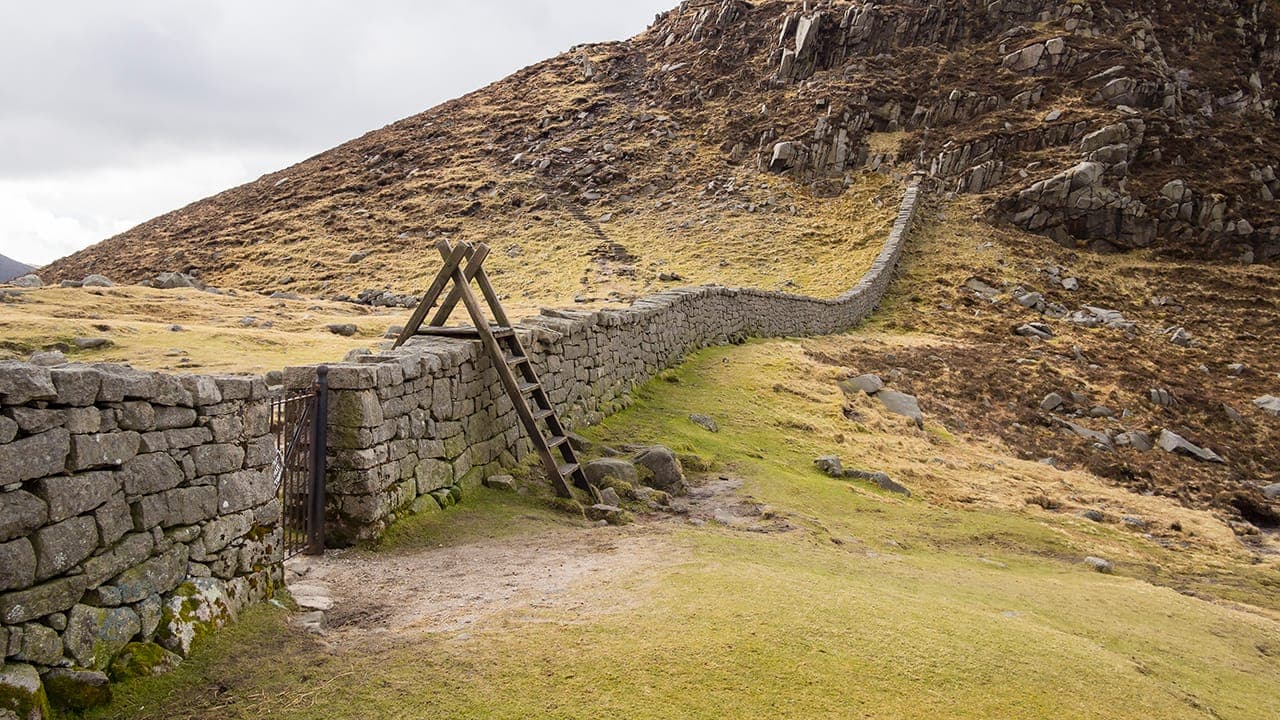
In 1904, the Belfast Water Commissioners had a problem. The catchment area above Silent Valley — the source of drinking water for Belfast and much of County Down — was open mountain. Cattle grazed freely. Farmers cut turf wherever they pleased. The water that flowed into the reservoir was not as clean as a growing city needed. The Commissioners’ solution was extraordinary: build a wall around the entire catchment. Not a fence. Not a boundary marker. A wall — dry-stone granite, shoulder-height, running across every summit and saddle that drained into the reservoir.
The contract went out. The men who answered it were local stonemasons, many of them from the farming families who had worked these mountains for generations. They knew the granite. They knew the weather. What they were about to do would take eighteen years.
“They climbed three hours in darkness before they could lift a single stone. Then they worked until the light ran out, and climbed back down again.”
Three Hours Before Work
The stonemasons camped in the mountains under canvas tarps, sleeping on the ground at altitude. Each morning they climbed for up to three hours just to reach their section of wall. There were no roads, no vehicles, no helicopters. Every tool, every flask of tea, every piece of equipment was carried on their backs. The granite itself was quarried on the spot — split from the living rock of each summit and shaped by hand.
The wall rises to about 1.5 metres along most of its length — high enough to keep livestock out of the catchment area. But the capping stones are the real feat. Each one weighs up to 120 kilograms and was hauled into position by hand, fitted so precisely that a century of Atlantic gales has not dislodged them. No mortar. No cement. Just the weight of one stone on another, locked together by craft alone.
“120-kilogram capping stones, carried up mountains by hand. No mortar. No cement. Just gravity and the skill of the stonemason.”
Cúig Déag Mullach — Fifteen Summits
The wall crosses fifteen of the Mourne summits in one unbroken line. From Sliabh Donard (Slieve Donard), Northern Ireland’s highest peak at 850 metres, it drops to the col and climbs again to Sliabh Commedagh. It threads through Hare’s Gap, climbs Sliabh Bearnagh (Slieve Bernagh) with its dramatic granite tors, runs along Sliabh Meelmore and Sliabh Meelbeg, crosses Sliabh Muck, and loops around to Beann Each (Slieve Binnian) with its summit like a broken crown.
The construction was not continuous. It started in 1904 and was interrupted by the First World War, when many of the stonemasons enlisted. Work resumed after 1918, and the wall was finally completed in 1922. Eighteen years from first stone to last. The men who finished it were not always the men who started it.
Still Standing
More than a century on, the Mourne Wall is still standing. Not as a ruin, not as a relic — as a functional structure. It still marks the catchment boundary. Maintenance crews still walk its length to repair storm damage. The granite is the same granite the stonemasons quarried from these summits, and the craft that held it together has outlasted every shortcut the 20th century could have offered.
It is one of the greatest feats of manual construction in Ireland. Not because it is tall, or decorative, or famous. Because a group of men walked into the mountains every day for eighteen years and built something that would last. They were paid by the metre. They slept under canvas. And the wall they built is still there, running from summit to summit, exactly where they left it.
“Eighteen years. Fifteen summits. Twenty-two miles of dry stone, built by men who slept in the mountains and were paid by the metre. It is still standing.”
The Place
Loading map...
The Mourne Wall route across the High Mournes — 22 miles linking 15 summits from <em>Sliabh Donard</em> to <em>Beann Each</em>.
The Mourne Wall is not hidden. It is one of the most visible structures in the Mourne Mountains — a line of granite that you can trace from almost every summit. You will encounter it on any serious walk in the High Mournes: the Slieve Donard ascent, the Brandy Pad, the Trassey Track, the route to Blue Lough. It is the constant companion of anyone who walks these mountains.
You can walk short sections of the wall as part of popular routes, or you can attempt the full Mourne Wall Challenge — a 35-kilometre circuit that follows the entire wall over all 15 summits. The challenge involves 2,440 metres of total ascent and typically takes around 15 hours. It is not a beginner’s walk. But shorter sections — particularly the stretch from Hare’s Gap over <em>Sliabh Bearnagh</em>, or the section climbing from the Carrick Little car park to <em>Beann Each</em> — are accessible to anyone with reasonable hill fitness.
Coordinates
Donard Car Park (Newcastle):
54.1968°N, 5.8795°W
Trassey Car Park:
54.1750°N, 5.9780°W
Carrick Little:
54.1330°N, 5.9250°W
Parking
Donard Car Park:
Pay & display. Fills early on summer weekends — arrive before 9am.
Trassey & Carrick Little:
Small free car parks with limited spaces. No facilities. Fill early in good weather.
Bloody Bridge:
Alternative access for southern sections. Small lay-by on the coast road.
The Visit
You don’t have to walk all 22 miles. You can encounter the wall on walks of any length — from a half-day out to an epic full-circuit challenge. Here are the options, from gentle to serious.
Trassey Car Park (Short Walk)
Hare’s Gap via the Trassey Track. You’ll meet the wall at the gap and can follow it up toward Sliabh Bearnagh. A moderate walk with spectacular views. 3–4 hours.
Donard Car Park (Summit Walk)
Slieve Donard from Newcastle via the Glen River. The wall meets you near the summit and continues over to Sliabh Commedagh. 4–6 hours.
Carrick Little (Binnian & Blue Lough)
The wall leads you up to Beann Each (Slieve Binnian), with its shattered granite tors. Drop down to Blue Lough on the return. 5–6 hours.
Duration
3–15 hours (depending on section). Short sections: 3–4 hours. Summit walks: 4–6 hours. Full Mourne Wall Challenge: approximately 15 hours.
Difficulty
Moderate to Extreme. Short sections are moderate. The full challenge is extreme — 35 km, 2,440 m of ascent, all 15 summits. Navigation skills, hill fitness, and good weather are essential.
What to Bring
- •Proper hiking boots — the terrain is rough, boggy, and rocky
- •Waterproof jacket and layers — summit weather changes fast
- •OS map (Sheet 29) and compass — mist is common on the summits
- •Plenty of food and water — there are no facilities on the route
- •Head torch for early/late starts on the full challenge
What to Look For
- •The capping stones — each one weighs up to 120 kg, placed by hand
- •The dry-stone technique — no mortar anywhere, just gravity and craft
- •Stonemason marks on some sections — individual signatures in the granite
- •The wall at Hare’s Gap — where it runs through the dramatic col
- •The line of the wall disappearing over distant summits — the drone shot everyone wants
Stand at Hare’s Gap and look both ways along the wall. To the east, it climbs to <em>Sliabh Bearnagh</em> and its granite tors. To the west, it drops and rises toward <em>Sliabh Meelmore</em>. You are standing in the middle of a 22-mile line of dry stone that men built by hand, one metre at a time. Let that settle in.
Make a Day of It
Walking sections of the Mourne Wall is a full mountain day. Combine it with a weekend that takes in the summits, the coast, and the best of the region.
While You're Here
Three places worth exploring once you’ve visited.
More Stories to Discover
Every mountain, bridge, and ruin has a story. Here are a few more.

Discover
Discover More Stories
The Mourne Mountains were shaped by ice, sea, and the people who refused to leave. Every summit, harbour, and lane has a story.
Explore All Stories