The Castle That Guarded Two Kingdoms
Two castles. Two kingdoms. One lough between them. For eight hundred years, Greencastle has watched the border from the southern shore of the Mournes.
Location
Near Kilkeel, Carlingford Lough
Time Needed
45–60 minutes
Built
1230s (Anglo-Norman)
Admission
Free — state care
Best Time
Clear day for lough views
The Story
The Lough Between Two Worlds
Carlingford Lough is a sea lough. It runs inland from the Irish Sea between the Mourne Mountains on the northern shore and the Cooley Mountains on the southern. Today it is the border between Northern Ireland and the Republic of Ireland. Eight hundred years ago, it was the contested frontier between two Anglo-Norman lordships — and before that, the boundary between the ancient kingdoms of Ulster and Louth. Control the lough, and you control the crossing between north and south. Both sides knew it.
In the 1230s, Hugh de Lacy — one of the most powerful Anglo-Norman lords in Ireland — built a castle on the northern shore to guard the entrance to the lough. He called it Greencastle. Directly across the water, barely two miles away as the crow flies, another fortress already stood: Carlingford Castle, built by his rival John de Courcy decades earlier. Two castles, staring at each other across a narrow stretch of water, each daring the other to move.
“Two castles on opposite shores, built by rival lords, staring at each other across the lough. One is now in Northern Ireland. The other is in the Republic. The border runs between them.”
A Fortress of Four Storeys
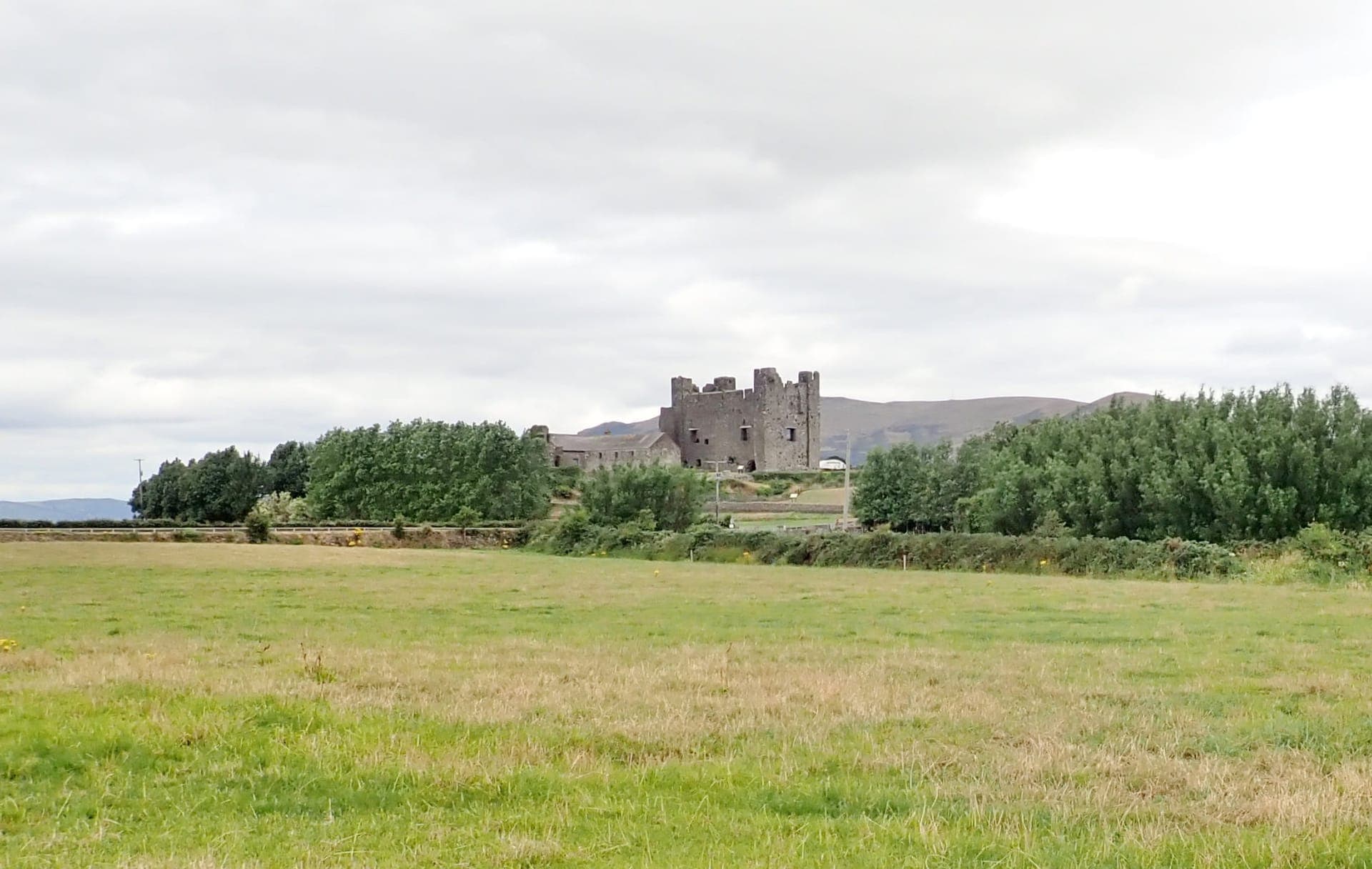
What Hugh de Lacy built was no minor fortification. Greencastle rose to four storeys — a massive rectangular keep of local granite and limestone, designed to dominate the shoreline and command views in every direction. From the upper floors, sentries could see ships entering the lough from the Irish Sea, watch the approach roads from Kilkeel (Cill Chaoil, ‘the narrow church’) and the Mourne coast, and — most crucially — keep an eye on Carlingford Castle on the opposite shore.
The castle was not just a watchtower. It was a royal castle — a seat of administrative power, a court, a garrison, and a symbol of English authority on the contested northern frontier. It controlled access to the lough, regulated trade and fishing, and projected military power across the water. In a landscape where loyalty shifted like the tide, Greencastle was a statement carved in stone: we are here, and we are staying.
“Four storeys of 13th-century stone, built to control a lough that is now an international border. The ambition of the Anglo-Normans is written in every course of masonry.”
Edward Bruce and the Scottish Invasion
In 1315, Edward Bruce — brother of Robert the Bruce, King of Scotland — landed in Ireland with a Scottish army. His aim was nothing less than a second front against the English crown: while Robert fought in Scotland, Edward would take Ireland. He marched south through Ulster, burning towns and besieging fortresses, and in 1316 his forces attacked Greencastle.
The assault on Greencastle was part of a wider campaign of devastation across the Mourne coast. Bruce’s Scottish soldiers swept through the region, and the castle — for all its thick walls — was damaged. But it survived. It was repaired, re-garrisoned, and continued to serve as a military and administrative base for decades afterward. The keep that stands today bears the scars of that period — patched masonry, altered doorways, the quiet evidence of a building that has been fought over and rebuilt and fought over again.
The Castle That Outlasted Its Purpose
By the late medieval period, the Anglo-Norman lordship that had built Greencastle had fragmented. The castle changed hands repeatedly — seized by Irish chieftains, reclaimed by English garrisons, damaged, repaired, and eventually abandoned as the strategic value of the site diminished and newer fortifications were built elsewhere. The roof fell in. The floors collapsed. The walls stood open to the Atlantic weather.
But the stone endured. Today Greencastle is in state care — a protected monument, open and free to visit. The keep still rises to its original height in places. You can trace the line of the upper floors in the stonework. You can stand in the great hall and look up at the sky where a vaulted ceiling once stood. And you can walk to the shore and look across the lough to where Carlingford Castle — its twin, its rival, its mirror — still stands on the opposite bank, now in a different jurisdiction, a different currency zone, a different country entirely.
“Stand at the shore below the castle and look south. Carlingford Castle is right there — close enough to see, far enough to be in a different country. The border runs through the water between them.”
The Place
Loading map...
Greencastle Royal Castle on the northern shore of Carlingford Lough — with Carlingford Castle visible on the opposite shore in the Republic of Ireland.
Greencastle sits on the southern shore of County Down, where the Mourne coast meets Carlingford Lough. The castle overlooks the narrowing of the lough where it opens to the Irish Sea — the exact point where any ship entering or leaving would have been most vulnerable.
The village of Greencastle is small and quiet — a handful of houses, a strand, and the castle ruins dominating the shoreline. Kilkeel is roughly 4 miles to the northeast along the coast road. The castle itself sits in a field beside the shore, with open views across the lough to the Cooley Mountains and the town of Carlingford on the far side.
Coordinates
Greencastle Royal Castle:
54.0700°N, 6.1000°W
Carlingford Castle:
54.0420°N, 6.1900°W
Parking
Roadside Parking:
From Kilkeel, follow the coast road southwest toward Greencastle Point. The castle is signposted. Roadside parking near the site.
The Visit
Greencastle is a state-care monument — free, open, and unattended. There is no visitor centre or cafe. This is you, a castle, and the lough. Allow 45 minutes to an hour to explore the ruins and take in the views.
Greencastle
Free and open at all times. The castle is in a field beside the shore — a short walk from the roadside. The ground is mostly grass and can be soft after rain.
Duration
45–60 minutes. Longer if you walk down to the shore to see the castle from water level and look across to Carlingford.
Difficulty
Easy. A substantial medieval keep with walls standing to near-original height in places. You can walk around and through the ruins. No barriers or railings — take care with children near the walls.
What to Bring
- •Sturdy shoes — the ground around the ruins is uneven
- •Binoculars to see Carlingford Castle in detail
- •No facilities on site — Kilkeel has cafes and shops
- •Dog-friendly, but keep dogs under control near the shore
- •Combine with a visit to Kilkeel harbour for a half-day trip
What to Look For
- •The view across to Carlingford Castle on the opposite shore
- •Floor-level marks in the stonework showing where upper storeys once stood
- •The thickness of the walls — several feet of solid stone
- •Patched masonry from medieval repairs after the Bruce attack
- •The Cooley Mountains and Mourne Mountains framing the lough
Walk to the shore below the castle and look south across Carlingford Lough. On a clear day, you can see Carlingford Castle on the opposite bank — the mirror fortress built to guard the other side of the same stretch of water. Two castles, built by rival lords, now in two different countries. The international border runs invisibly through the water between them.
Make a Day of It
Greencastle is a natural stop on the Mourne coastal drive. Combine it with Kilkeel harbour, Annalong Cornmill, and the coast road through to Newcastle.
While You're Here
Three places worth exploring once you’ve visited.
More Stories to Discover
Every mountain, bridge, and ruin has a story. Here are a few more.
Discover
Discover More Stories
Castles, dolmens, and ruins hidden in the landscape — the Mourne region is full of places that most visitors drive straight past. Every ruin has a story.
Explore All Stories