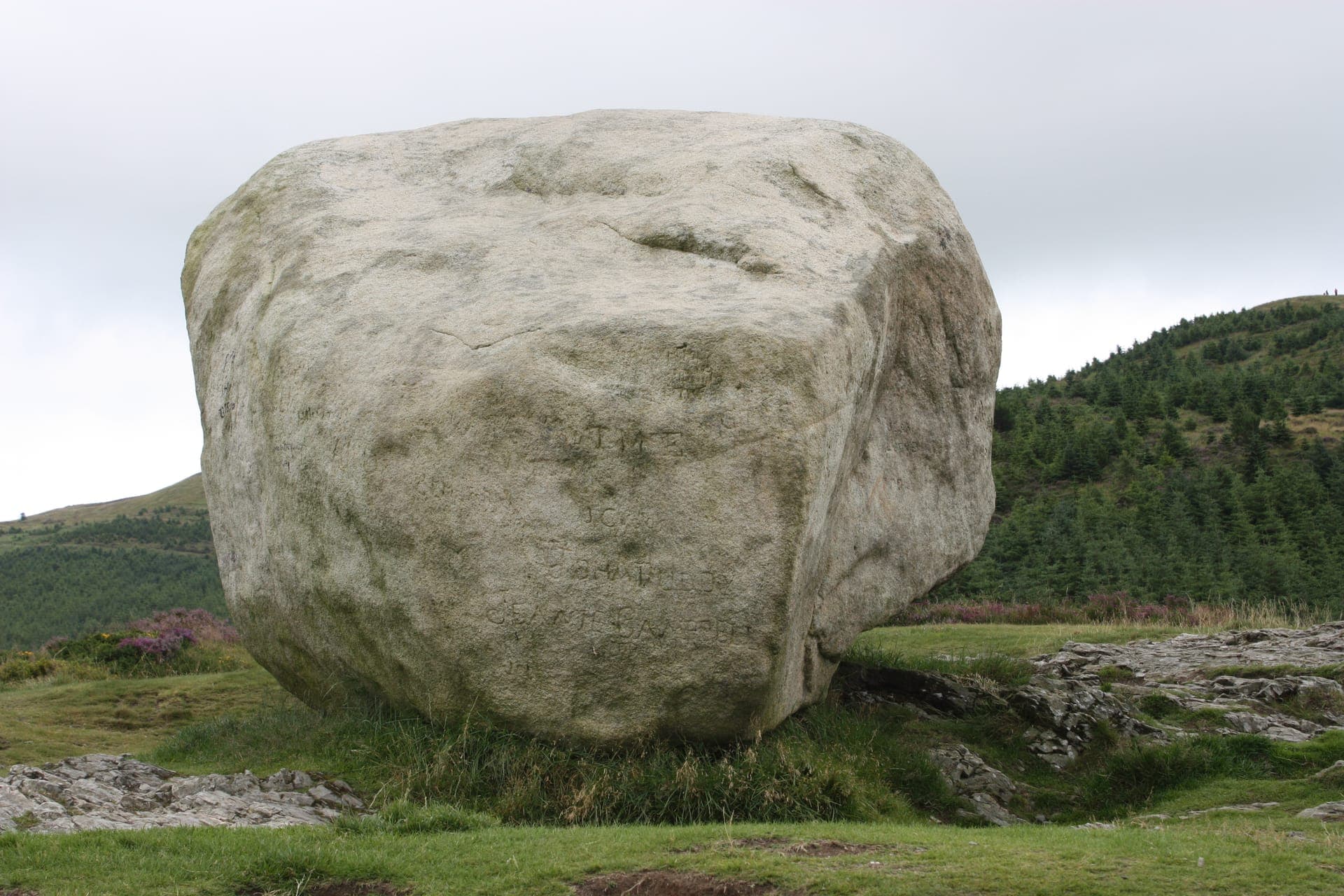
A 5,000-Year-Old Mystery in a Farmer’s Field
A 50-tonne capstone balanced on ancient stones, sitting in open farmland near Hilltown. They call it Finn’s Finger. It has been here for five thousand years.
Location
Goward, near Hilltown
Time Needed
30–45 minutes
Age
~4,500 years (2500 BC)
Admission
Free — always open
Best Time
Sunset for dramatic light
The Story
Older Than the Pyramids
Sometime around 2500 BC — five centuries before the Great Pyramid at Giza was finished, a thousand years before Stonehenge took its final form — a community in the foothills of what we now call the Mourne Mountains raised a slab of granite weighing approximately 50 tonnes and balanced it on upright stones. Then they left it there. And it has not moved since.
The Goward Dolmen — or Goward Portal Tomb, as archaeologists prefer — sits in a farmer’s field two miles west of Hilltown (Baile an Chnoic, ‘the town on the hill’), between the village and Castlewellan. There is no visitor centre. No gift shop. No interpretive panel telling you what to think. Just a massive stone structure in an open field, with the Mourne Mountains rising behind it, exactly as it has been for four and a half thousand years.
“Fifty tonnes of granite, balanced on stone, in the middle of a field. It was ancient before the Celts arrived. It was ancient before the Romans built their roads. And it is still standing.”
Finn’s Finger
Locally, the dolmen has been known for centuries as Finn’s Finger — Méar Fhinn in Irish — named after the great warrior Fionn Mac Cumhaill (Fionn Mac Cumhaill), the giant of Irish mythology whose legends cling to every mountain and lake in this landscape. According to the storytellers, the capstone is the tip of Fionn’s finger, thrust up through the earth from some subterranean slumber. Or that Fionn flung it here from the summit of Slieve Donard. Or that he used it as a stepping stone across the bog. The story changes depending on who you ask and which pub you ask in.
What the archaeologists can tell us is more measured but no less remarkable. Goward is a portal tomb — a type of megalithic monument found across Ireland and western Britain, dating from the Neolithic period. The massive capstone rests on upright portal stones, tilted at an angle, creating a chamber beneath. These structures are thought to have been funerary monuments — places where the dead were laid, perhaps cremated, and honoured.
“In 1834, excavations at the dolmen uncovered a cremation urn and a flint arrowhead — the belongings of someone buried here four thousand years ago.”
What They Found Beneath
In 1834, antiquarians excavated beneath the capstone. What they found confirmed what the structure’s form had long suggested: this was a burial place. A cremation urn was recovered, along with a flint arrowhead — grave goods placed with the remains of someone who died in the Bronze Age, when the fields around the dolmen would have been cleared for farming and the surrounding hills grazed by cattle.
The urn and arrowhead have long since been taken into museum collections. But the dolmen itself — the thing they built to mark the burial, the monument meant to outlast everything — remains exactly where it was placed. The farmers have ploughed around it for millennia. Cattle graze beside it. The field boundaries have shifted. The language has changed from Irish to English. Empires have risen and collapsed. And the capstone sits there, unmoved, in the quiet of a County Down field.
The Extraordinary in the Ordinary
What makes Goward so arresting is not just its age or its engineering — though both are staggering. It is the contrast. This is not a monument in a museum. It is not behind glass, or roped off, or lit by spotlights. It is in a working farmer’s field. You walk through a gate, cross a patch of rough grass, and there it is — a structure raised by Neolithic hands, still standing, with sheep watching you from the next field over and the Mourne Mountains filling the sky behind.
That juxtaposition — the mundane and the monumental, the everyday and the eternal — is what Ireland does better than almost anywhere on earth. You do not need a ticket. You do not need a guide. You just need to stand beside it, put your hand on stone that has been standing since before writing was invented, and let the scale of it settle in.
“You walk through a gate, cross a patch of grass, and there it is. A tomb from the age of stone, with sheep grazing beside it and the Mourne Mountains behind.”
The Place
Loading map...
Goward Dolmen — in a farmer’s field two miles west of Hilltown on the road toward Castlewellan.
The dolmen sits in open farmland on the Goward Road, roughly halfway between Hilltown and Castlewellan. The townland of Goward (<em>Gabhar</em>, likely from the Irish for ‘goat’) is a quiet farming area on the northern slopes of the Mournes, where the land begins to flatten toward the Lagan Valley.
From the roadside, a short walk across farmland brings you to the dolmen itself. The approach is simple and unmarked — look for a field gate and a worn path through the grass. The capstone is visible from the road in most seasons, but you need to walk right up to it to appreciate the scale: roughly 13 feet across, tilted at an angle, balanced on portal stones that have not shifted in five millennia.
Coordinates
Goward Dolmen:
54.1900°N, 6.1300°W
Parking
Roadside Parking:
Take the Goward Road from Hilltown toward Castlewellan. The dolmen is approximately 2 miles from the village. Roadside parking near the field gate.
The Visit
Visiting Goward Dolmen is one of those rare experiences where the simplicity is the point. No queues. No audio guides. Just you, a field, and a 5,000-year-old stone structure. Allow 30–45 minutes to walk out, spend time at the dolmen, and take in the views.
Goward Road
Free and open at all times. A short walk through farmland from the roadside. The path is not paved — wear boots or sturdy shoes, especially after rain.
Duration
30–45 minutes. Longer if you time it for sunset and want to linger with the light.
Difficulty
Easy. Flat farmland. Easy walking for all ages and abilities. The field can be muddy in wet weather. No stiles — access through a field gate.
What to Bring
- •Sturdy shoes or wellies — the field is often soft
- •A camera — the dolmen photographs beautifully
- •Respect for the farmland — close gates behind you
- •No facilities on site — Hilltown village is 2 miles away
- •Dog-friendly, but keep dogs on leads near livestock
What to Look For
- •The sheer scale of the capstone — stand beside it
- •The tilt of the stone and how it balances on the portals
- •The chamber beneath — where the cremation urn was found
- •The Mourne Mountains framing the backdrop to the south
- •Lichen and weathering patterns on the granite surface
Stand right beside the capstone and look up. The scale is impossible to appreciate from a distance. Up close, you can see the texture of the granite, the way the stone has weathered over millennia, and the extraordinary precision of the balance. Then look south — the Mourne Mountains fill the skyline, and you realise that the people who raised this stone were looking at the same mountains you are.
Make a Day of It
Goward Dolmen pairs perfectly with a heritage day through the Mournes — ancient monuments, castle ruins, and 5,000 years of history in a single drive.
While You're Here
Three places worth exploring once you’ve visited.
More Stories to Discover
Every mountain, bridge, and ruin has a story. Here are a few more.
Discover
Discover More Stories
Dolmens, ice houses, and ruins hidden in the heather — the Mourne region is full of places that most visitors walk right past. Every field has a story.
Explore All Stories