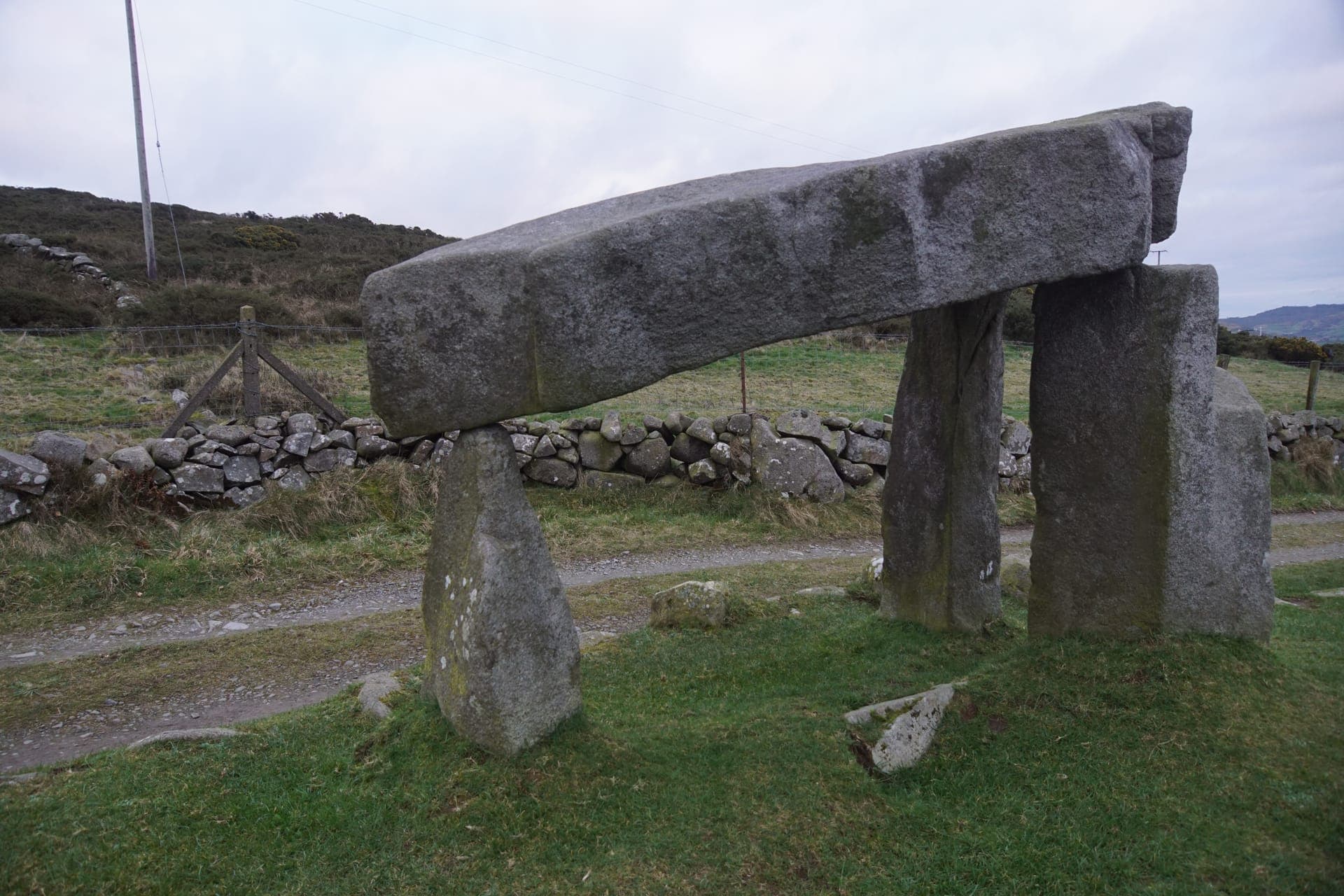
The Dolmen With the Best View in Ulster
A 3-metre capstone balanced on three slender legs, on the slopes of Slieve Croob. The entire Mourne range spread out before it. It has been here for five thousand years.
Location
Slieve Croob, near Castlewellan
Time Needed
20–30 minutes
Age
~5,000 years (Neolithic)
Admission
Free — always open
Best Time
Clear day for Mourne views
The Story
Three Legs, Five Millennia
Sometime around 3000 BC, on the southern slopes of a mountain the Irish would later call Sliabh Crúibe — the Mountain of the Hoof — a Neolithic community raised a slab of granite roughly 3 metres long and balanced it on three slender upright stones. The capstone tilts slightly forward, as though caught in the act of taking a bow. It has not moved since.
This is Legananny Dolmen — Liag an Eannaigh, possibly ‘the flagstone of the fair’ or ‘the flagstone of Eanach’, though the etymology is debated. What is not debated is that it is one of the most photographed ancient monuments in Ireland, and the reason is not just the stone itself. It is what sits behind it. From this spot on Slieve Croob, the entire Mourne Mountain range — from Slieve Donard to Slieve Muck — stretches across the southern horizon like a painted backdrop. The dolmen stands in the foreground as it has stood for five thousand years, framing the mountains with the precision of a gallery installation.
“Three narrow stones hold up a slab of granite that has been balanced here since before the Bronze Age began. Behind it, the entire Mourne range fills the sky.”
The Engineering of Wonder
What makes Legananny exceptional among Ireland’s 190 or so portal tombs is its form. Most dolmens rest on broad, blocky supports — heavy stones that look as though they are shouldering the weight of the capstone through brute force. Legananny is different. The three supporting stones are tall and narrow, almost delicate by megalithic standards, giving the monument a tripod silhouette that looks improbable from every angle.
Stand in front of it and you’ll find yourself looking for the trick — the hidden fourth leg, the concrete repair, the iron brace. There is none. The Neolithic builders who raised this stone understood weight distribution, leverage, and the properties of local granite with an intuition that modern engineers still find difficult to explain in purely practical terms. They chose this spot, quarried these stones, shaped these supports, and lifted this capstone into position using nothing but human effort, wooden levers, and an understanding of physics that predates the word physics by four thousand years.
“No mortar. No metal. Just granite balanced on granite, by people who had not yet discovered bronze, on a hillside where the view has not changed in fifty centuries.”
The View They Chose
Archaeologists believe Legananny was a burial monument — a portal tomb where the dead were placed beneath or beside the capstone, perhaps with grave goods, and honoured by the community. But there is a question that the archaeology alone cannot answer: why here?
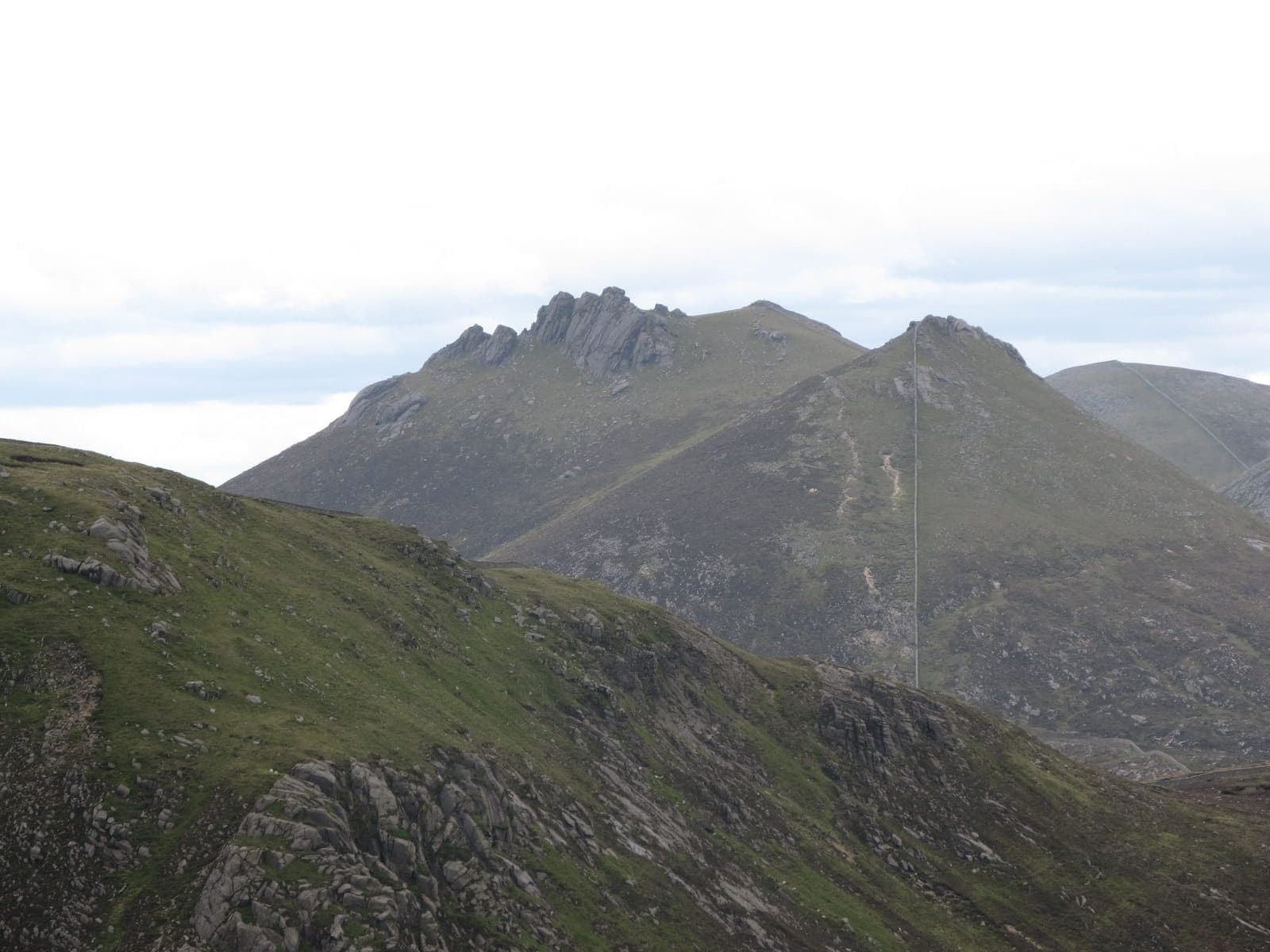
Slieve Croob — Sliabh Crúibe, at 532 metres — is the highest peak in the Dromara Hills, and the dolmen sits on its southern flank, oriented toward the Mourne Mountains. On a clear day, the view from Legananny extends across the patchwork farmland of County Down to the entire Mourne skyline: Sliabh Donard, Sliabh Commedagh, Beann Each, Sliabh Meelbeg and Sliabh Meelmore — the peaks the Neolithic builders would have known as the most prominent landmarks in their world.
It is difficult to stand here and not conclude that the view was deliberate. These were not people scattering monuments at random. They chose this elevation, this angle, this orientation, so that whoever was buried here — whoever was honoured here — would rest for eternity facing the mountains. Five thousand years later, the mountains are still there, and the dolmen is still facing them.
“They chose this hillside so whoever rested here would face the mountains for eternity. Five thousand years later, the mountains are still there. And so is the dolmen.”
The Place
Loading map...
Legananny Dolmen — on the southern slopes of Slieve Croob, south of Dromara and Finnis, in the townland of Legananny.
The dolmen sits in open farmland on the southern slopes of Slieve Croob (<em>Sliabh Crúibe</em>), in the townland of Legananny. It is roughly 8 miles northwest of Castlewellan and about 5 miles south of the village of Dromara. The surrounding landscape is rolling drumlins and hedgerow-lined fields — classic County Down countryside.
From the roadside, a 2-minute walk along a signposted path brings you to the dolmen. There is a small lay-by for parking right beside the access point. The monument is a state-care site maintained by the Northern Ireland Environment Agency, with a low fence and an information plaque — but otherwise no infrastructure. Just you, the stone, and the mountains.
Coordinates
Legananny Dolmen:
54.3200°N, 5.9800°W
Parking
Roadside Lay-by:
From Castlewellan, take the road north toward Dromara. The dolmen is signposted from the Legananny Road. A lay-by beside the access point provides free parking for several cars.
The Visit
This is one of the easiest ancient monuments in Ireland to visit. No hill walk. No muddy field crossing. Just a lay-by, a 2-minute stroll, and a Neolithic tripod dolmen with the best mountain panorama in Ulster. Allow 20–30 minutes — longer if the sky is cooperating.
Legananny Road Lay-by
Free and open at all times. A signposted grass path leads from the lay-by to the dolmen in about 2 minutes. Flat terrain, suitable for most ages and abilities.
Duration
20–30 minutes. Photographers often spend an hour waiting for the right light.
Difficulty
Easy. Open farmland on a gentle slope. The path is grass but firm in most seasons. No stiles or gates to negotiate. Sturdy shoes recommended but not essential in dry weather.
What to Bring
- •A camera with a wide-angle lens for dolmen + mountains
- •Check the weather before you go — cloud cover hides the Mournes
- •No facilities on site — nearest village amenities in Dromara or Castlewellan
- •Dog-friendly — keep dogs on leads near livestock
What to Look For
- •The tripod silhouette — three narrow stones supporting the capstone
- •The slight forward tilt of the capstone, as if bowing toward the mountains
- •The Mourne Mountain panorama to the south — every major peak visible
- •Weathering and lichen on the granite surface — five millennia of exposure
- •The orientation — the dolmen faces the mountains, and it feels intentional
Walk around the dolmen and look at it from every angle. From the south, it is a classic portal tomb. From the north, the three slim uprights give it a skeletal, almost insect-like silhouette against the sky. But the view that defines Legananny is from behind it, looking south: the ancient stone in the foreground, the Mourne Mountains filling every inch of the horizon beyond. That composition is the reason this is one of the most photographed ancient monuments in Ireland.
Make a Day of It
Legananny Dolmen sits on the slopes of Slieve Croob with the entire Mourne range spread before it. Pair it with a heritage day through the region or a full weekend of summits and ancient stones.
While You're Here
Three places worth exploring once you’ve visited.
More Stories to Discover
Every mountain, bridge, and ruin has a story. Here are a few more.
Discover
Discover More Stories
Dolmens, ice houses, and ruins hidden in the heather — the Mourne region is full of places that most visitors walk right past. Every field has a story.
Explore All Stories